Reconstruction era
News of the WorldThe Reconstruction era in the novel is not a settled aftermath but a contest over authority, movement, and memory. Texas remains under military rule while partisan officials, the United States Army, local armed groups, and Indigenous communities exercise overlapping or conflicting power. Against that instability, Jefferson Kyle Kidd’s effort to take Johanna Leonberger home becomes more than a private errand: the route repeatedly tests who has the right to transport, protect, detain, or claim her.
A state in political flux
The novel presents postwar Texas as a society in which the status of free Black people is still unresolved in the minds of much of the population. In North and West Texas, free Black men work as freighters and scouts, and the Tenth U.S. Cavalry is described as an all-Black regiment. The juxtaposition makes clear that Black people are already part of the region’s economic and military life even as their place in the wider social order remains unsettled. The narration calls this condition a flux: unstable, liable to catch fire.
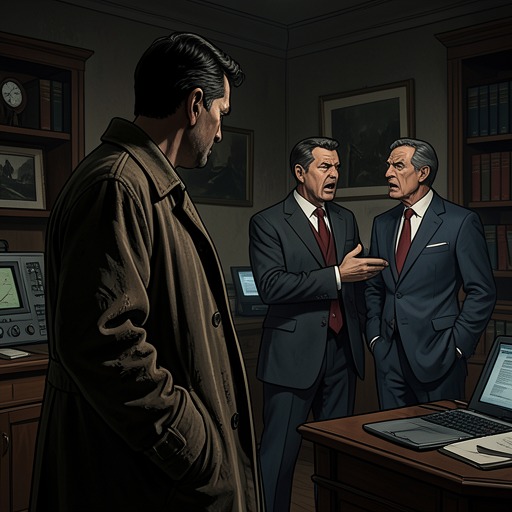
That uncertainty is also institutional. At one public reading, the state is still under military rule, and the political struggle is described not as a contest between the old Southern Democratic Party and Union-loyal Republicans, but as a conflict between two Republican factions. The faction led by Governor Davis seeks dictatorial powers; the faction led by Hamilton is presented as less extreme. Both, the account says, are robbing the state. Washington has not yet seated the Texas delegation, and the unresolved political situation leaves people with little confidence that an appeal to a congressman will settle a land title. The Betancort title, in particular, is expected to occupy Elizabeth for years.
The failure of government becomes concrete in Erath County. A group tells Kidd that there is no local administration, sheriff, justice of the peace, mayor, or commission. Former officials had served in the Confederate Army or under the Confederacy; Davis and the United States Army removed them, but no replacements were sent. The group claims that it has taken over the work of governing and holds Kidd accountable to it. The scene shows a vacuum not as an abstraction but as a dispute over who may make rules and enforce them.
Law, custody, and contested authority
The journey with Johanna begins within this contested system. Her parents and little sister were killed in the raid in which she was taken. Her relatives, Wilhelm and Anna Leonberger, sent a paper identifying her and a fifty-dollar gold piece for her return to Castroville, passed north through a major from San Antonio. An Indian Agent was to hand the money to someone who could transport her home; Britt Johnson accepted the task of getting her out of Indian Territory and across the Red River. The formal paperwork and payment establish a recognized claim by her relatives, but they do not make the journey safe or resolve the deeper question of who has authority over a child taken into another community.
Kidd suggests that the United States Army might deliver her, since soldiers had taken charge of captives. Britt answers that this is no longer so. Later, a mounted Army patrol appears on the road, and Kidd conceals Johanna beneath her wool blanket while the soldiers approach. During the questioning, he denies carrying a handgun, and the lieutenant inspects the wagon’s supplies. Kidd’s evasions and the soldiers’ scrutiny put the state’s power into an everyday encounter: a legal restriction on carrying handguns has force even on the frontier, while the escort’s purpose and the girl’s safety remain matters of negotiation rather than simple administrative procedure.
The novel does not present law as a single, dependable order. Kidd privately condemns the Reconstruction government and the handgun law, while the county scene shows local authority absent altogether. Meanwhile, the Indian Agent’s role in returning captives gives an official channel to a process that also depends on relatives’ petitions, money, intermediaries, and a dangerous crossing. Jurisdiction shifts with the road: state law, military presence, local self-government, and the Agent’s authority do not combine into a consistent protection for Johanna.
Roads, rivers, and the borderlands
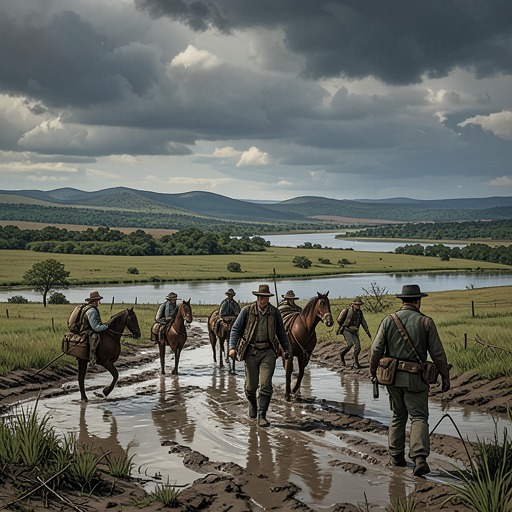
Physical movement makes those political boundaries palpable. Kidd and Johanna cross the upper Little Wichita near its junction with the Red River at a run. The current rises around the wagon; the mare goes under and strikes bottom, while Pasha plunges in after them and comes out downstream. The crossing leaves a broken iron tire that they cannot repair before reaching Spanish Fort. The scene makes passage depend on water, animals, equipment, and improvisation as much as on any official permission.
Later, Kidd and Johanna evade Almay and his Caddo companions by initially taking the Waxahachie Road south instead of the expected route southwest. He hopes the false trail will buy them several hours, then plans to cut west and approach the Brazos River before daylight. Their safety depends on knowing how pursuers might read roads and tracks, and on the possibility of watching from high ground. The landscape is not empty space between authorities: it channels escape, pursuit, and observation.
The threat of raids is likewise shaped by geography. Comanche raiders mostly come south from the Red River across open, arid country around Lampasas, where dust raised by their horses can be seen for miles. They skirt towns and forts, then favor the hill country, where concealment, water, isolated farms, loot, and the absence of soldiers offer different advantages. Kidd responds by keeping to the sides of rises so the wagon will not be silhouetted and stopping to listen and watch for signs of riders. His precautions register how little formal protection reaches the countryside.
News, communication, and public life
The same precarious network that carries people also carries information. In Dallas, Kidd visits a printing establishment whose hand-fed press turns out announcements and advertisements. He buys newspapers from Philadelphia, Chicago, London, New York, and Mexico City, intending to select and translate articles for his readings. He also visits the Dallas Weekly Courier and pays to take news from the Associated Press wire, which still operates from Arkansas and points east.
That wire is both a channel of news and an instrument of military power: Comanche and Kiowa people know that Army orders travel over telegraph lines. They cut the wire and mend it with horsehair so it will no longer transmit, while leaving the break difficult to detect. Communication is therefore not neutral infrastructure. Its interruption is a tactical act, and the line’s vulnerability reveals how authority depends on a system that can be quietly disabled.
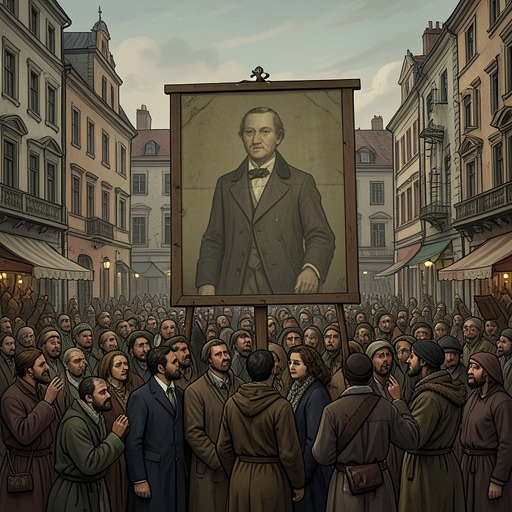
Kidd’s readings turn distant events into public encounters. At the Broadway, he arranges the light from his bull’s-eye lantern over the printed page, places his gold hunting watch on the podium, and reads to a crowd that pays coins at the entrance. The audience hears about events and places beyond its immediate experience, including cattle packing in Chicago and Irish arrivals in New York. In a state where formal government is disputed and transportation is hazardous, the newspaper performance offers a shared, if temporary, way to imagine a wider world.
Aftermath and remembered lives
The novel’s account of the era reaches beyond the immediate journey. Britt Johnson, Paint Crawford, and Dennis Cureton are killed by Comanche people in 1871 while freighting near Graham in North Texas. They are caught on the only open stretch between Graham and Indian Mound Mountain and buried where they fall. The episode gives later force to the exposure that freighters and scouts face on the region’s roads; the gravestone remains where the men were buried.
The closing reflections also set different forms of survival beside one another. Simon and Doris raise six children, all musicians, and travel through North Texas performing Irish jigs and cowboy ballads. The Horrell brothers continue their crimes until several are killed in the Lampasas Square Shoot-Out of 1877. At San Fernando Cathedral, the old sanctuary and altar dome remain from the structure built in 1733 even after a new front is added; the Betancort graves have been moved south of the San Antonio River, while some earlier Spanish settlers’ bones remain beneath the floor. The Kiowa warriors, by contrast, are said to endure in stories told and retold, alongside accounts of their bravery, the deaths of Britt Johnson and his companions, and Johanna’s life among them as Three Spotted’s blue-eyed girl.
These endings resist a picture of Reconstruction as a clean transition from war to order. Institutions are displaced or distrusted, people and goods move along exposed routes, and communications can be cut as readily as they can be used. What persists is uneven: a gravestone, a family’s music, an old sanctuary, and stories that continue to carry the lives of people whose political and cultural worlds the novel shows in conflict.